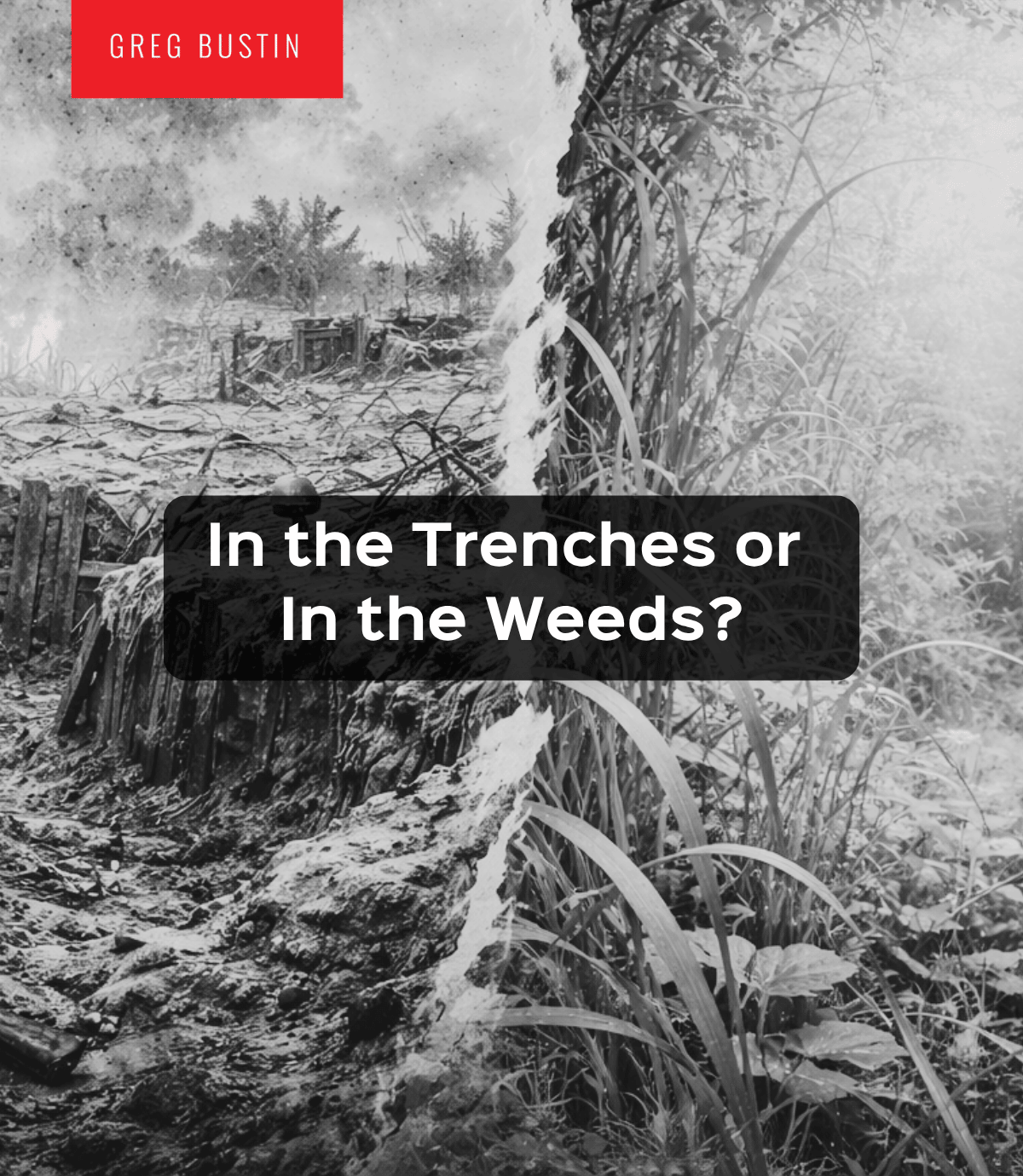
In the Trenches or In the Weeds?
April 7th, 2026 |

The Fine Line Between Leading & Managing
There are lots of ways to lead.
Just ask Amazon. Eleven thousand new business books are published every year in the U.S. alone and “leadership” is the primary sub-genre. Currently, more than 57,000 active titles on Amazon’s site have “leadership” in the title.
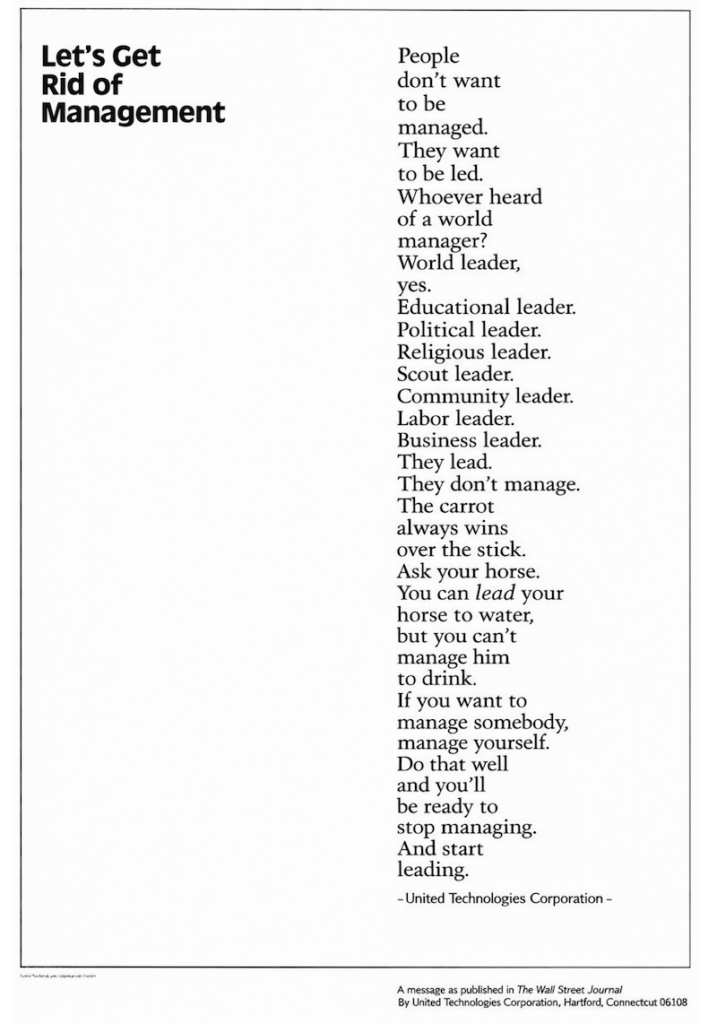
Or ask your horse, as Harry Gray, CEO of United Technologies from 1975 until 1986, suggested in this ad he wrote that appeared in the Wall Street Journal:
Or ask your people. How would they describe your leadership style?
Warren Bennis, considered the “father” of modern leadership practices and author of thirty books, was among the first people to distinguish between managers and leaders, noting “The manager has his eye on the bottom line; the leader has his eye on the horizon.”
In my twenty years as a Vistage Chair, I’ve seen all kinds of leaders. Great, awful and in between.
I’ve been fortunate to have been led by three terrific bosses.
Jean Farinelli was my toughest boss and among my greatest champions. She demanded and got the best from us. Her observation early in my career that I had a “lazy mind” lit a fire in me that continues to burn and prompts me to ask: “Have I done my best?”
Jim Cox helped me navigate the complexities of an international organization. He brought a cool head to problems and focused us on possibilities, not limitations. Jim and I butted heads early then together found our groove. From that point forward he always had my back.
Mike Rawlings was a big picture thinker, which you’d expect from the leader of a national advertising agency. Mike became Pizza Hut’s president and later became one of the finest mayors of the City of Dallas. Mike would cast the vision, provide leaders with the resources to execute, and, when necessary, help people find common ground. He believed in me and helped me start my own business.
The best bosses know what matters most. They challenge and inspire. They lead from the front lines of business without getting in the weeds.
When you’re in the weeds, you’re limiting your growth and the growth of your team. You’re holding on to tasks others can handle. You’re likely doing this for one of three reasons:
- You find comfort and satisfaction doing that type of work.
- You have an outsized need for control.
- You’ve got the wrong person in the role so you don’t trust others to do the work.
This style of leadership is far from inspiring. You’re entangled in details and decisions below your pay grade, leaving yourself little time to think strategically. You’re micromanaging.
Conversely, when you lead from the trenches – a phrase coined from the brutal, muddy and dangerous front-line warfare of World War I – you’re jumping in to lend support, you’re getting an up-close look at your people and their challenges, and you’re inspiring your team to push forward doing difficult, gritty, unglamorous tasks.
Leading from the trenches is working alongside someone – it doesn’t mean doing their work.
Leading is difficult. Three factors provide clues to your leadership style.
Commander’s Intent
The word “strategy” gets tossed around and some people don’t know its meaning—just that saying it makes them sound smart or gives importance to an activity that’s really a tactic, like a “strategic update.”
Derived from the Greek word meaning “generalship,” the word “strategy” is based on the idea of a competitive advantage and describes how you win.
For centuries, wars were planned by generals and their primary strategies were force, time, logistics and surprise. Objectives, terrain, weather, army size, the commander’s experience and troop temperament combined to determine an army’s plans once the enemy was within striking distance. Generals usually made decisions far from the battlefield. Soldiers implemented those decisions.
In the 1800s, military thinking shifted to the idea of commanders conveying their intent rather than justissuing orders, allowing battlefield leaders flexibility to use their judgment and initiative to adapt to changing circumstances while still achieving the overall goal.
In business, the idea of the commander’s intent took longer to catch on. As the business world moved from manufacturing’s hierarchical systems to the complexities of managing what Peter Drucker called “knowledge workers,” it became useful for workers to understand why they were being asked to do certain things and how those activities contributed to the overall objective.
Ask: Do the people in our organization know our purpose beyond making money?
Role Clarity
Wherever you find an accountability problem you’ll discover clarity is absent.
Many times, this lack of clarity is related to a person’s role in the organization.
In the small and mid-size businesses I work with regularly, it’s not uncommon for people to do two jobs. At some point, doing two jobs is like fighting a war on two fronts. It can be done, but the ambiguity about which of the two is more important and the dilution of effort reduces performance in two places.
Ask: Do the people in our organization know what’s expected of them?
Delegating vs. Assigning
And that brings us back to your style of leading.
Do you delegate tasks or assign them?
My experience working with leaders is that many leaders believe they are delegating tasks when they are really just assigning tasks.
Here’s the difference: When you delegate a task you are transferring responsibility and authority. Delegation empowers the recipient to make decisions and solve problems. Without asking. They own their decisions.
When you assign a task, you are transferring only the responsibility to complete the assignment. Nothing more.
Ask: How much authority have I vested in my people so they can make decisions without me?
The Building Blocks of Destiny
In my workshop on decision-making, we examine a framework to help think about decision-making.
If you’re interested in receiving a free one-page PDF that provides this framework, send me an email and I’ll send you the PDF.
There are lots of ways to lead. Are you in the trenches or in the weeds?

Ready to reset?
Attend my free Accountability webinar: I Did It! to set and achieve your 2021 goals.

- February 17th from 11 AM – 12:30 PM Central Time
- My free webinar will help you:
– Sharpen your personal goals
– Improve time management
– Tackle tough work-related issues
– Support remote workers
Learn More
To dive even deeper into the topic of accountability, I invite you to purchase a copy of my bestselling book, “Accountability: The Key to Driving a High-Performance Culture.”
Become a better leader.
Download my three free e-books.

Free Tips
Sign up to receive free tips on business, leadership, and life.
Get My Latest Book
HOW LEADERS DECIDE
History has much to offer today’s current and aspiring leaders.
Business schools teach case studies. Hollywood blockbusters are inspired by true events.
Exceptional leaders are students of history. Decision-making comes with the territory.