Spring Cleaning with a Devilish Twist
March 3rd, 2026 |


The Perils of Leadership
Spring arrives early in Texas.
My speaking engagements this year have already taken me to Toronto, Detroit, Portland and La Crosse, Wisconsin. Residents of those cities tell me they’ve gotten used to dealing with leftover snow, slush and chilly temps as they count the days toward sunshine and warmer weather.
I’m just now thawing out from those trips.
In Texas, the temps will soon sprint toward 100° F (37° C for non-U.S. readers), but for now, this time of year in Texas is tops.
It’s a great time to be outdoors, and it’s also a time when people give serious consideration to spring cleaning and garage sales.
The idea of spring cleaning is almost as old as civilization itself. Neanderthals may have moved from cave to cave, but modern homo sapiens needed to clean up.
In Scotland, Ireland and other countries with Gaelic heritages, the celebration Hogmanay combines cleaning with the end of the year and gift-giving. For the Persian new year—Nowruz—the custom of khooneh tekouni (“shaking the house”) occurs as the old year and accumulated debris are ushered out. And there’s the Jewish practice of thoroughly cleansing the home in anticipation of Passover’s spring-time feast, a remembrance of the Israelites’ hasty exodus from Egypt.
Even the Devil knows it’s a good time to tidy up.
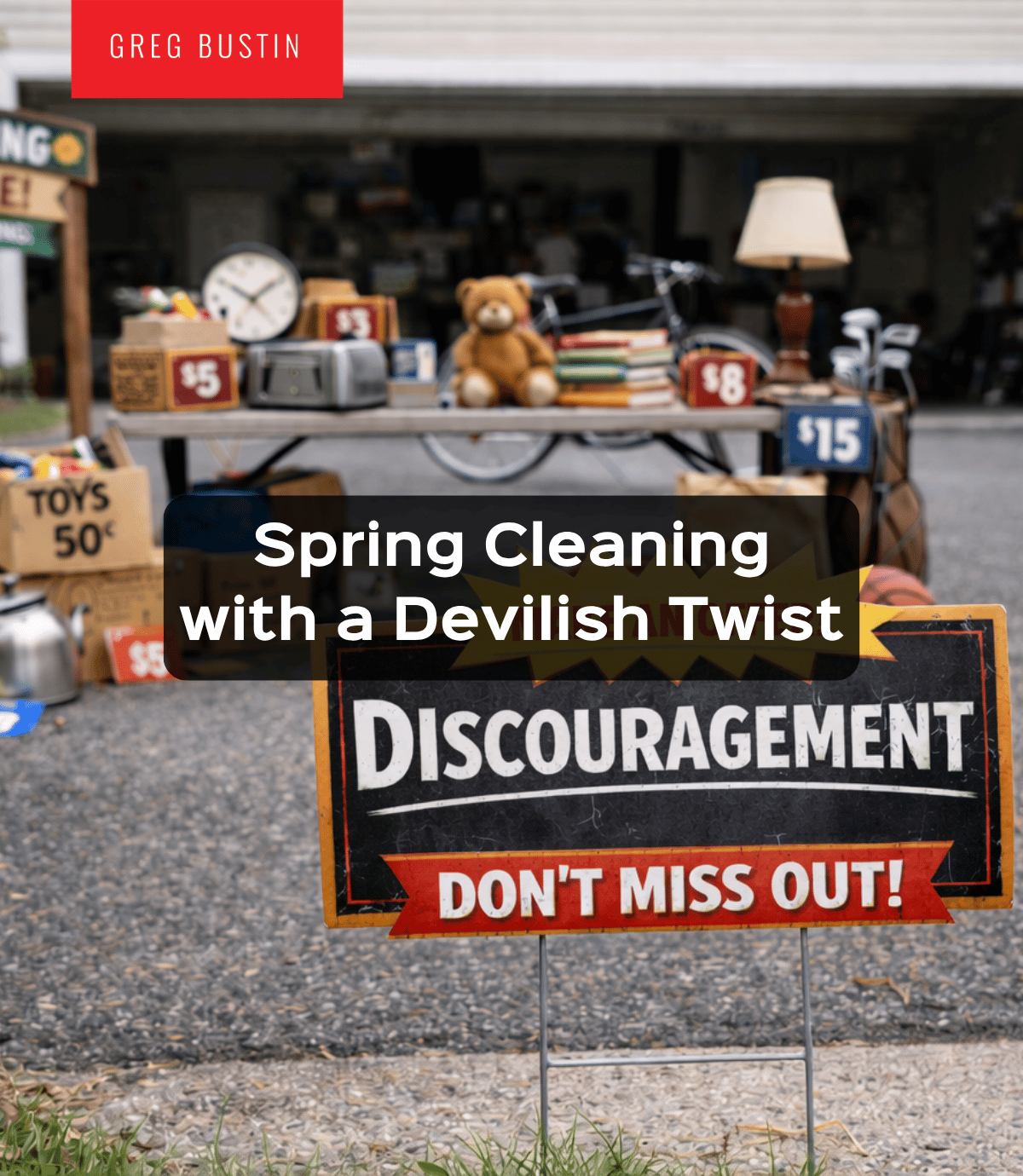
The Devil’s Garage Sale
When I was a young business owner, I belonged to a peer advisory group of other owners led by John Dealey, a descendant of George Bannerman Dealey, a civic leader and early publisher of The Dallas Morning News and for whom Dealey Plaza is named.
I owe a lot to John because he and the group helped me navigate multiple challenges and, in a round-about way, John was responsible for me becoming a Vistage Chair twenty years ago.
During one particularly tough time for me as a young business owner, John shared with me a version of the following story—which, even at that point, had already been around for some time.

Perhaps this tool has been used on you.
Lonely at The Top
It’s natural that all of us, from time to time, will feel discouraged.
Leaders can become overwhelmed by the magnitude of their responsibilities, beaten down by having their decisions second-guessed, or simply find themselves questioning whether they’re meant to lead.
As a leader in my forties, I had doubts about myself.
I didn’t know it then, but there’s a psychological phrase for those feelings. It’s called “Impostor Phenomenon” and the phrase was coined in 1981 by Joan C. Harvey. The idea is that high-achieving individuals fear being exposed as frauds despite evidence of their success. I’d heard it called “Impostor Syndrome” but it’s the same thing: You live in a state of anxiety worried you owe more to luck than talent and that any day those around you will realize you’re a phony.
If you’ve ever felt this way, you might want to check out If I’m So Successful, Why Do I Feel Like a Fake? The Imposter Phenomenon written by Harvey and Cynthia Katz in 1985. Like most good books, it’s timeless.
I survived this fragile period by joining John Dealey’s group and by saying “yes” when Richard Hearne (who I knew only from seeing him seated a couple of pews behind us) invited me to join a small group of men who met every Tuesday morning.
It’s certainly helpful to belong to a group of smart people who can help you work though business issues. It’s just as important to be able to lean on people who will convince you that you’re enough.
It’s lonely at the top. The Devil is always willing to join you. Don’t let him.

Ready to reset?
Attend my free Accountability webinar: I Did It! to set and achieve your 2021 goals.

- February 17th from 11 AM – 12:30 PM Central Time
- My free webinar will help you:
– Sharpen your personal goals
– Improve time management
– Tackle tough work-related issues
– Support remote workers
Learn More
To dive even deeper into the topic of accountability, I invite you to purchase a copy of my bestselling book, “Accountability: The Key to Driving a High-Performance Culture.”
Become a better leader.
Download my three free e-books.

Free Tips
Sign up to receive free tips on business, leadership, and life.
Get My Latest Book
HOW LEADERS DECIDE
History has much to offer today’s current and aspiring leaders.
Business schools teach case studies. Hollywood blockbusters are inspired by true events.
Exceptional leaders are students of history. Decision-making comes with the territory.