Why Wait? Answer These 7 Questions Now
October 7th, 2025 |

For a Fulfilling Life, You Need to Answer These Questions Sooner or Later
Last month, we examined ten questions you should be asking about strategic planning.
Today we’ll address seven questions everyone needs to answer—sooner or later—for themselves in order to reach their potential and live a fulfilling life.
I came face to face with the first three questions twenty years ago. Even though my name was on the door of the firm I founded, after a while it seemed I was doing what was expected and not what I enjoyed.
These questions are so deceptively simple I’d taken them for granted. Once I started thinking about them I realized I hadn’t answered them fully or honestly. Getting clear about the answers helped me walk away from a successful career and start a new career that’s been more rewarding by every measure I consider important.
I can’t promise answering these seven questions will help you the way they helped me, but I believe you’ll find the journey of exploring the questions worthwhile.
1. What do I stand for?
Our values describe our noblest traits that inform our decisions and propel us toward our goals. They’re our non-negotiable principles, and we make decisions guided by them. Twenty years ago I thought figuring out my core values was unnecessary. Yet situations arise every day that test us. If we’re not sure what we stand for, we’ll flunk the test. I was flunking lots of tests.
What principles matter most to me?
2. What are my strengths?
Trying to improve a skill you don’t like or aren’t good at is wasted effort. As a rule, people like doing the things they’re good at doing. So rather than investing time becoming good at something you’re average at, invest your time becoming great at things you’re good at. Great leaders are lifetime learners and they’re curious about what makes people and things tick. They’re curious about how they can become better. Understand how you learn best. Continue learning. Because when you’re done learning, you’re done.
What leadership habits do I want to add, remove or improve in the year ahead?
3. What do I want?
My career was built on strengths that led to me starting my own firm, which was a mountaintop achievement. But three years after opening the doors I told my father I wasn’t happy. He listened then offered advice that shaped my leadership journey over three decades. He said that what worked for him was doing what he loved with people he cared about at a place he cared about. “What about the money?” I asked. “If you take care of those first three things,” he told me, “the money will come. Besides, how much is enough if you’re not happy?”
In August, I published my seventh edition of recommended reading, “Summer Reading.” In Know What Matters, Panera founder Ron Shaich considers what’s next as though he’s on his deathbed. “I try to evoke the feelings I want to have in that moment—a sense of peace, completion and, most importantly, self-respect,” Shaich writes. “Then I ask myself: What am I going to do now to ensure that when I reach that ultimate destination, I’ve done what I need to do?”
Download for free this personal planning template I call the 7 Fs to think about what matters most to you.
What goals do I want to accomplish in the year ahead? What causes these goals to excite me?
4. Whose job am I doing?
There are many ways for leaders to get stuck and stop growing. One way is when they hold on to tasks that others can handle. This can occur because a leader finds comfort and satisfaction doing that type of work. Other times it’s because there’s an outsized need for control. Or it’s because they’ve got the wrong person in a role so they don’t trust others to do the work. These behaviors limit people. To maximize your impact, delegate what you can and focus your energy on where you add the greatest value to the organization. If you’re doing someone else’s job, who’s doing yours?
Am I working on the things that I and only I can do?
5. How do I care for myself?
Exercise, diet and R&R are critical components of any person’s well-being. Reserve time to replenish your physical and mental energy. A rested body provides stamina for the race. A relaxed mindset is more creative and more receptive to new ideas. Explore new worlds—whether it’s across town or across the ocean—to access different parts of your heart and mind and to open new avenues for imaginative problem-solving and creative thinking. Exercise keeps your mind sharp and your body limber. See your doctor and dentist regularly. The greater the responsibility, the greater the need to care for yourself.
Where do I place myself on my list of priorities?
6. Am I as accountable as I should be?
Accountability is a powerful force that starts with choosing an ideal future then keeping your word to yourself to attain your objective. That means it’s both foolish and duplicitous to expect others to be accountable to their goals when you’re not accountable to yours.
For insights about personal accountability, download this free eBook from my website, “Success Starts with Me.”
What promises do I make that I have difficulty keeping?
7. Am I living a life of gratitude?
Living a life of gratitude is like harnessing a super-power that opens hearts, minds and possibilities. Gratitude starts by acknowledging we owe a debt to someone for the relative success we enjoy: a loved one, a teacher, a coach, a mentor, a friend. Do these people know how much they mean to you? Gratitude grows as we become aware of life’s little miracles. Gratitude blossoms as we live a life of abundance, not scarcity. Life is short. Enjoy it.
For what or for whom am I grateful?
You’re successful. But even successful people can improve. What are you waiting for?

Ready to reset?
Attend my free Accountability webinar: I Did It! to set and achieve your 2021 goals.

- February 17th from 11 AM – 12:30 PM Central Time
- My free webinar will help you:
– Sharpen your personal goals
– Improve time management
– Tackle tough work-related issues
– Support remote workers
Learn More
To dive even deeper into the topic of accountability, I invite you to purchase a copy of my bestselling book, “Accountability: The Key to Driving a High-Performance Culture.”
Become a better leader.
Download my three free e-books.

Free Tips
Sign up to receive free tips on business, leadership, and life.
Get My Latest Book
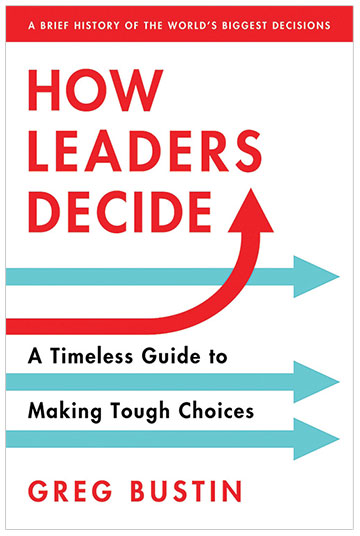
HOW LEADERS DECIDE
History has much to offer today’s current and aspiring leaders.
Business schools teach case studies. Hollywood blockbusters are inspired by true events.
Exceptional leaders are students of history. Decision-making comes with the territory.