How Will This Year be Different?
January 6th, 2026 |

Making 3 Choices Can Help You
Many people will use the change in the year to consider how they might change their behaviors to become a better version of themselves.
Some might even call it turning over a new leaf.
Did you know this phrase has nothing to do with a leaf from a tree?
In the sixteenth century, pages in a book were called leaves so turning over a new leaf was equated to beginning a new page in your diary. You’re turning to a new, clean page and you’re leaving behind the past for a fresh start.
But a fresh start means little without the right mindset, the right habits and the right people around you.
Look for the Gift
In Positive Intelligence, Shirzad Chamine notes that people with a positive mindset perform more effectively, are more innovative and are better problem-solvers.
A century ago, Henry Ford said, “If you think you can do a thing or think you can’t do a thing, you’re right.”
Life is filled with choices, and when it comes to mindset, our first choice is choosing to be grateful versus choosing to be a victim of our circumstances.
I’m not suggesting you sugarcoat negative circumstances. Rather, I’m inviting you to find the gift in something terrible. You can do it. I did.
As the 55-person consulting firm with my name on the door struggled to survive, what had become the worst experience of my business life morphed into a new career that’s been fulfilling on so many levels beyond what I could’ve imagined twenty-five years ago.
Life happens. How you adapt, set a new goal and move forward is a choice.
One more benefit of adopting a positive mindset: Research shows you’ll live up to ten years longer.
Ask: How can I reframe a negative thought, event or situation into one that’s positive?
A Little Structure is a Big Help
If you’re like me, you’ve probably completed lots of personality assessments.
One thing I’ve learned about myself is that I appreciate structure. This confession could surprise my more methodical and analytical friends who may see me as spontaneous and even a little unprepared. But the truth is that structure helps me focus and I’m most creative when I understand the guardrails. Knowing the boundaries allows me to choose when to color outside the lines. Some of my most impactful ideas spring from breaking rules.
It’s the same with habits. They can propel us forward or hold us back.
Habits are the structure we build into our lives.
Habits, by my way of thinking, are linked to time management. For seven ideas to manage your time more effectively, check out my post “Where Did The Time Go?”
A habit, according to a 1903 paper in the American Journal of Psychology, is a “more or less fixed way of thinking…acquired through previous repetition of a mental experience.” More recently, a study by researcher Wendy Wood and her colleagues found that approximately forty-three percent of daily behaviors occur out of habit.
New behaviors can become automatic as new habits are formed. But old habits are hard to break and new habits are hard to form. If you want to be more accountable to yourself and you’re curious about how forming new habits can help with this work, check out my post “The Season of Accountability.”
Ask: What habit no longer serves me? What leadership habit do I want to develop or enhance this year?
Angels and Saboteurs
You may have heard that you’re the average of the ten people with whom you spend the most time.
Maybe you believe it. Maybe you don’t. I believe it.
During my business struggles twenty-five years ago, my wife Janet was a huge source of encouragement.
She provided unwavering support and lots of helpful ideas. To remind me to stay strong and keep the faith (and perhaps to remind me to be patient and considerate), she gave me a pocket angel.

I’ve lost the original she gave me and I’ve lost several more of these little tokens over the years, but I always replace them and I always carry one in my pocket.
This small token of faith also reminds me that my strengths—when over-exercised—can quickly turn against me. My high-achieving strength can cause me to disregard people, processes and rules in order to accomplish a desired outcome. My focus on the big picture can sabotage my attention to detail. My sense of urgency may show up as impatience.
Having the right people around us can provide encouragement, offer different perspectives and illuminate blind spots. That’s the power of peer groups and it’s the fulfilling work I’ve been doing for twenty years with the leaders who are members of my Vistage groups.
Ask: Who are the ten people in my life with whom I spend a significant amount of my time? Are they pulling me up or holding me back?
Who Am I?
As you step into a new year and consider your mindset, your habits and your most trusted advisors, unlock this anonymous riddle – and your success – using clues provided thus far:
I am your constant companion. I am your greatest helper or heaviest burden. I will push you onward or drag you down to failure. I am completely at your command. Half the things you do might just as well be turned over to me, and I will be able to do them quickly and correctly.
I am easily managed – you must merely be firm with me. Show me exactly how you want something done and after a few lessons I will do it automatically. I am the servant of all great people; and, alas, of all failures as well. Those who are great, I have made great. Those who are failures, I have made failures.
I am not a machine, though I work with all the precision of a machine plus the intelligence of a human being. You may run me for profit or turn me for ruin – it makes no difference to me.
Take me, train me, be firm with me and I will place the world at your feet. Be easy with me and I will destroy you.
Who am I?
I am habit.
“Excellence,” said Aristotle, “is not an act but a habit.”
Here’s wishing you a fulfilling next twelve months.

Ready to reset?
Attend my free Accountability webinar: I Did It! to set and achieve your 2021 goals.

- February 17th from 11 AM – 12:30 PM Central Time
- My free webinar will help you:
– Sharpen your personal goals
– Improve time management
– Tackle tough work-related issues
– Support remote workers
Learn More
To dive even deeper into the topic of accountability, I invite you to purchase a copy of my bestselling book, “Accountability: The Key to Driving a High-Performance Culture.”
Become a better leader.
Download my three free e-books.

Free Tips
Sign up to receive free tips on business, leadership, and life.
Get My Latest Book
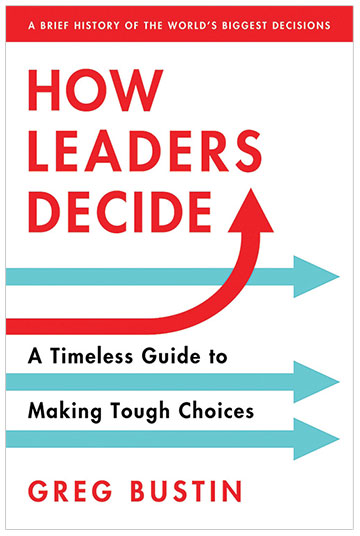
HOW LEADERS DECIDE
History has much to offer today’s current and aspiring leaders.
Business schools teach case studies. Hollywood blockbusters are inspired by true events.
Exceptional leaders are students of history. Decision-making comes with the territory.